Led by your surgeon
FUE hair transplant in Istanbul
FUE takes hair roots out one at a time from the back of your head and moves them to where hair has thinned. No strip of skin is removed, so there is no line scar. Your surgeon takes out grafts personally, with an experienced technician team working under their direction.
i
- Anaesthesia
- Local
- Donor marks
- Tiny dots, no line scar
- Usually chosen for
- Bald areas, some hairlines
- Full result
- 12–18 months
Is it right for you?
Who it suits
- Areas that are bald or nearly bald, at the front, top or crown.
- Rebuilding a hairline, where channels opened with a sapphire blade can sit very close together.
- People with a healthy donor area that has not had many grafts taken before.
- People who are happy to have their head shaved for the procedure.
Who should wait, or choose something else
- People who need to keep their hair long; unshaven procedures, when your surgeon agrees to one, are usually done with DHI.
- Thinning areas where plenty of your own hair remains; DHI places grafts between existing hairs more precisely.
- Anyone who wants to keep the back shaved to the skin, as tiny pale dots may show.
- A thin donor area, or one that was over-harvested in an earlier surgery.
- Hair loss that is still changing quickly or has another cause, such as alopecia areata.
Not sure what you need?
Send four photos. Our lead surgeon replies with your plan, a graft estimate and the full price, in writing.
Free, no obligation
What is FUE?
What it costs
- Procedure only, from
- €1,720£1,480US$1,999
- With hotel and transfers, from
- €2,450£2,090US$2,850
The same surgery in every package, sapphire FUE, DHI or both as your surgeon decides, with lunch on the day, your first wash and the medicines after surgery. Packages differ in hotel nights, PRP and aftercare.
Priced per package, not per graft: fixed, all taxes included, confirmed in writing before you travel.
What each package includesWhat a hair transplant in Istanbul costs
Hair transplantation is surgery. Risks include infection, scarring, shock loss and grafts that grow poorly. Read about the risks
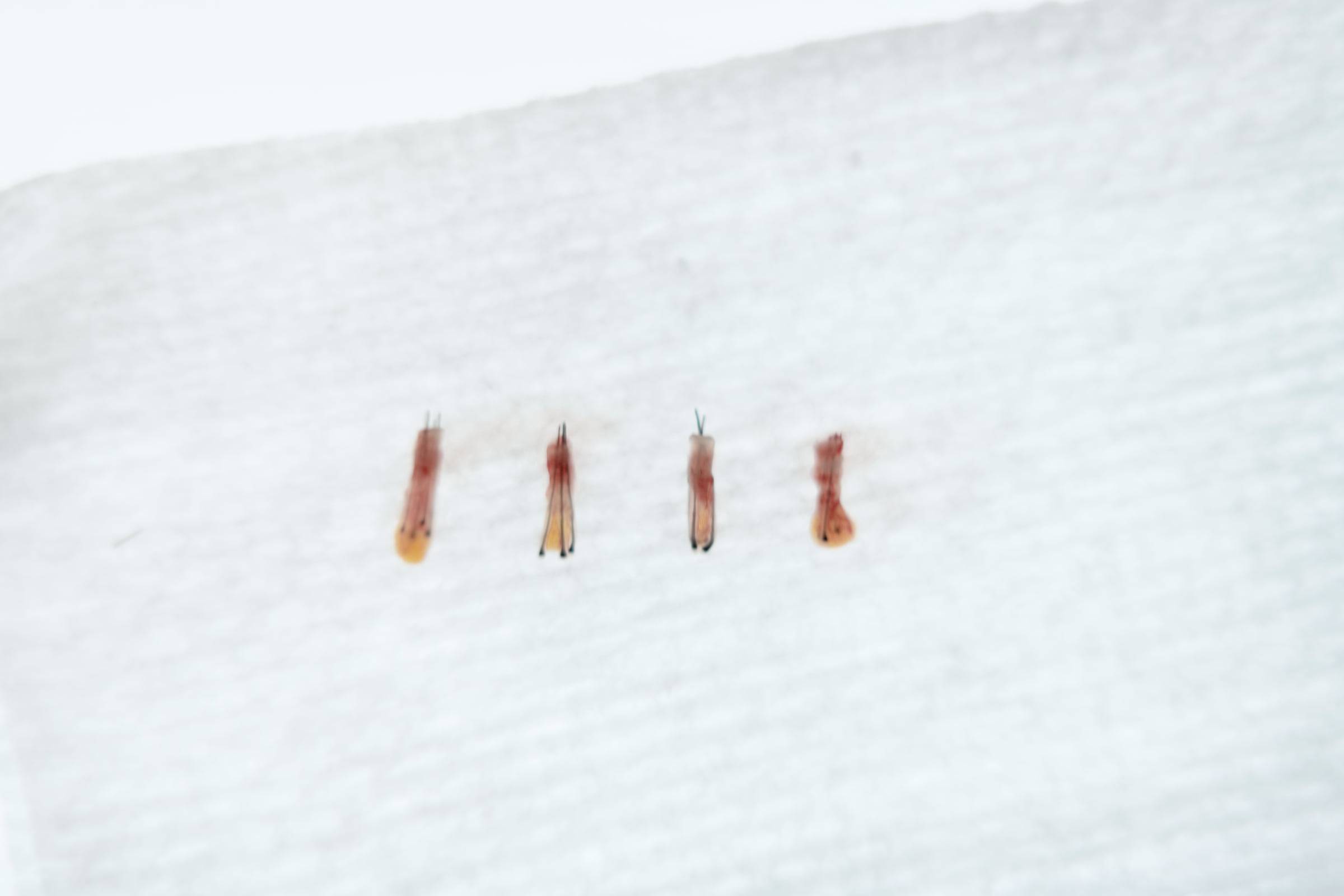
FUE stands for follicular unit extraction. Hair grows in tiny natural groups of 1–4 hairs, called follicular units. In FUE, these units are taken out one at a time with a tiny round punch, usually 0.8–1 mm wide. They are then moved to where hair has thinned.
Because no strip of skin is cut away, there is no line scar. Each punch leaves a small round wound that heals into a pale dot. Once your hair has grown back a few millimetres, these dots are hard to see.
FUE is also the first half of every technique we use. Sapphire FUE and DHI take grafts out in exactly this way. They differ only in how the grafts go back in.
How FUE works
Taking grafts out
Extraction decides two things: how many grafts survive, and how your donor area looks for the rest of your life. Hair roots sit under the skin at an angle, so the punch is lined up with each one under magnification. A misaligned punch can cut through the root, and that graft may not grow.
Grafts are taken evenly from the safe donor zone: the band at the back and sides where hair is most resistant to pattern loss. Grafts taken from outside it may later be lost to the same pattern loss. Taking only a fraction of the hair from any one spot keeps the back of your head looking full. Taking too many from one place leaves thin, patchy areas that are hard to repair later. That is one reason we never take more than 5,000 grafts in one session, for anyone.
The safe donor zone. The band at the back and sides where hair resists pattern hair loss. Most donor areas give 4,000–6,000 grafts in a lifetime.
Keeping grafts healthy
Out of the body, grafts are fragile. Drying out, warmth and rough handling all reduce the chance that a graft will grow. That is why grafts wait in a cool, moist storage solution, are handled gently, and spend as little time out of the body as practical.
Opening channels and placing grafts
Every graft needs its own small opening in the skin, called a channel. The angle and direction of each channel decide how the hair will lie, so they follow the way your own hair grows. At the hairline, channels are angled low so the hairs point forward. The first 2–3 rows get single-hair grafts only; behind them go grafts with 2, 3 or 4 hairs, depending on what your donor area gives.
Who opens the channels. Your surgeon, personally, with a sapphire blade. An experienced technician team places the grafts under their direction.
Density is planned zone by zone, at about 40 grafts per cm² along the hairline and fewer behind it. At Dr. Grafts, your surgeon opens every channel personally with a sapphire blade, which lets channels sit very close together at the hairline. An experienced technician team then places each graft into its channel with fine forceps, under your surgeon’s direction, and your surgeon checks the work at every stage. Our sapphire FUE page explains what the blade does and does not change.
FUE, sapphire FUE or DHI?
| Compared | Classic FUE | Sapphire FUE | DHI |
|---|---|---|---|
| Taking grafts out | Punch, one by one | The same | The same |
| Making the openings | Steel blade or needle, before placing | Sapphire blade, before placing | The implanter opens and places in one move |
| Shaving | Usually a full shave | Usually a full shave; rarely unshaven | Full or partial; unshaven is possible but usually not advised |
| At Dr. Grafts | Not used: we open channels with sapphire blades | Bald or nearly bald areas, and some hairlines | Thinning areas with existing hair, women, second procedures, many hairlines |
Opening all the channels first lets the team work quickly and evenly over a bald area, and the sapphire blade allows close packing at the hairline. DHI places each graft precisely between existing hairs, so our surgeons use it where you still have hair. Some patients have both in one procedure, for example sapphire FUE where the scalp is bald and DHI where hair is thinning. Your surgeon decides this case by case, and both techniques cost the same. FUE extraction is part of every package, so there is no separate FUE price.
Results and recovery
The small wounds in the donor area close within a few days, and the pale dots fade further over the following weeks. The back of your head may feel tight or numb for a while. Shaved hair grows back to a short, even length within a few weeks.
In the treated area, scabs usually come away with gentle washing by day 10–14, and redness fades over the same time. Most transplanted hairs shed between weeks 2 and 8, and new growth starts around month 3–4. Our recovery timeline shows the full sequence, up to 18 months for the crown.
Risks and side effects
FUE has the general risks of any hair transplant: swelling, temporary numbness, spots (folliculitis), shock loss of existing hair, infection (rare) and grafts that grow poorly. Some risks come from the way grafts are taken out:
- Over-harvesting. Taking too many grafts, or taking them from outside the safe zone, can leave the back visibly thin. This is hard to correct later.
- Damaged grafts. If the punch cuts across a root, that graft may not grow. The right punch size and careful alignment keep this low.
- Visible dots. With a skin-close shave or under bright light, the pale dots can show.
This is why it is worth asking any clinic who will do each step. Our guide on how to choose a clinic lists the questions to ask any clinic, including us.
Sources
- Follicular unit extraction: minimally invasive surgery for hair transplantation – Rassman WR, et al. Dermatologic Surgery, 2002 (PubMed)
- Distribution of human hair in follicular units. A mathematical model for estimating the donor size in follicular unit transplantation – Jimenez F, Ruifernández JM. Dermatologic Surgery, 1999 (PubMed)
- Review of factors affecting the growth and survival of follicular grafts – Parsley WM, Perez-Meza D. Journal of Cutaneous and Aesthetic Surgery, 2010 (PubMed)
- Hair Transplant Practice Guidelines – Mysore V, et al. Journal of Cutaneous and Aesthetic Surgery, 2021 (PubMed)
- Complications in Hair Transplantation – Kerure AS, Patwardhan N. Journal of Cutaneous and Aesthetic Surgery, 2018 (PubMed)
How it works, step by step
Tests and design
On surgery day you have blood tests. Then your surgeon draws the hairline with you and checks your donor hair under magnification.
Shave and numb
The donor area and the area to be treated are shaved. Local anaesthetic, with adrenaline to reduce bleeding, numbs both.
Take out grafts
Grafts are taken out one by one with a fine punch, spread evenly across the donor area; your surgeon takes out grafts personally. They are sorted by number of hairs and kept cool.
Open channels
Your surgeon opens a tiny channel for each graft personally, with a sapphire blade, at the angle and direction they plan to match your natural hair.
Lunch, then placing
After lunch, which is included, an experienced technician team places the grafts with fine forceps under your surgeon’s direction: single-hair grafts in the first 2–3 rows, larger grafts behind. Your surgeon checks the work, then you go back to your hotel.
Who does what
Your surgeon leads your whole procedure
Ask any clinic you are considering who will actually do each step of your procedure. Here is what doctor-led means at Dr. Grafts.
- Your plan and your hairline
- Our lead surgeon plans every procedure, with both surgeons on complex cases. On the day, your surgeon draws your hairline with you at the mirrorDonor hair is limited, so the plan protects it for later
- Taking out the grafts
- Your surgeon takes out grafts personally, with an experienced technician team working under their directionCareful extraction protects the donor area
- Opening the channels, or the DHI pen
- Your surgeon, personally: opens the channels in sapphire FUE, or places the grafts with the DHI pen in DHIThe most important steps: they set the angle, direction and density of your new hair
- Patients per day
- Usually two to three, with our two surgeonsYour surgeon leads every step and checks the work at each one, though not beside you every minute
- Where
- Surgery takes place in the operating rooms of licensed hospitals in Istanbul, Turkey
- Aftercare and follow-up
- Your coordinator and your surgeon, for 12 monthsAnything unusual can be picked up early
Questions
Questions about FUE hair transplant
Will the back of my head look thin after FUE?
With well-spread extraction, the donor area usually looks much as it did once the hair grows back, though it is slightly less dense. Grafts are taken from across the whole area and within its safe limits, so the remaining hair covers the gaps. We never take more than 5,000 grafts in one session.
How short can I cut my hair at the back after FUE?
Once healed, most people can wear a short clipper cut, as a few millimetres of hair usually hides the tiny dots. With a skin-close shave, the pale dots may show, especially under bright light. If you like a skin fade, tell us during your assessment so we can plan for it.
Is sapphire FUE a different operation from FUE?
No. The grafts are taken out in exactly the same way. The only difference is the blade used to open the channels where the grafts go. The planning, the skill involved and the recovery are the same. At Dr. Grafts, every channel is opened with a sapphire blade.
Can beard hair be used in an FUE transplant?
Yes. If your scalp donor area is not enough, grafts can be taken from the beard by FUE. They come from under the chin and on the neck, where gaps are least noticeable. Beard hair is coarser, so it usually goes into the crown or mid-scalp rather than the hairline.
Will I need more than one FUE session?
Most people need one. At Norwood 6–7, and in some Norwood 5 cases, we always plan two: the hairline and front first, then the crown at least 8–9 months later. We never take more than 5,000 grafts in one session, and the total always has to fit within your lifetime donor supply.
Is FUE hair transplant right for you?
Send four photos. Our lead surgeon replies with your plan, graft estimate and full price, usually within 24 hours. Free, and you are not committing to anything.
Like any surgery, a hair transplant has risks. They include infection, scarring, shock loss and grafts that grow poorly. Read about the risks