From your own blood
PRP hair treatment in Istanbul
Platelet-rich plasma (PRP) is made from a small amount of your own blood and injected into the scalp. It may help thinning hair and healing after a transplant, but it cannot regrow hair where follicles have gone.
i
- Session time
- About 45–60 minutes
- First course
- 3–4 monthly sessions
- Top-ups
- Every 3–6 months
- Downtime
- Usually none
Is it right for you?
Who it suits
- Early pattern thinning in men or women, where hairs are getting finer but are still there.
- Transplant patients, to support healing and the hair around the grafts.
- People already using medication who want to add another option, after talking to their doctor.
- Anyone who accepts that results vary and that sessions need repeating.
Who should wait, or choose something else
- Bald, shiny areas where the follicles have gone: PRP cannot bring them back.
- Blood or platelet disorders: tell us, because PRP may not be safe for you.
- Blood thinners: tell us before booking, and never stop them on your own.
- An active scalp infection or skin flare, or current cancer treatment: tell us, as PRP usually waits.
- Pregnancy or breastfeeding: PRP is usually postponed until afterwards.
Not sure what you need?
Send four photos. Our lead surgeon replies with your plan, a graft estimate and the full price, in writing.
Free, no obligation
What is PRP?
Platelets are tiny cells in your blood that help wounds heal. They carry proteins called growth factors. PRP, short for platelet-rich plasma, is the clear liquid part of your blood (plasma) with more platelets in it than normal.
When PRP is injected into the scalp, its growth factors are thought to support hair follicles. In early thinning, this may help hairs that are getting finer to grow thicker again. Because PRP is made from your own blood, the risk of an allergic reaction to it is very low.
How a session works
A session usually takes about 45–60 minutes from start to finish. Most of that time is preparation: the blood draw, a short wait while the centrifuge runs, and getting your scalp ready. The injections themselves are only a short part of the visit.
Your doctor injects small amounts of plasma across the thinning areas, a short distance apart. Clinics prepare PRP in different ways, with different machines, spin times and platelet levels. This is one reason why results differ between studies.
What the evidence says
PRP has positive randomised trials, most of them small. Many small studies in pattern hair loss show more hairs or thicker hairs after a few sessions. Others show little or no benefit, and because the methods differ so much, the studies are hard to compare. There is still no agreed standard for how PRP should be prepared or how often it should be given.
In short. PRP has positive randomised trials in pattern hair loss, most of them small, and results vary from person to person. The studies are on our sources page.
Studies do point the same way on who tends to respond. People with early thinning, where hairs are getting finer but the follicles are still there, usually do better than people with advanced loss. The effect also tends to fade if sessions stop. Think of PRP as support for your own hair, not a replacement for medication or surgery.
PRP, medication or a transplant?
PRP is one of three main options for pattern hair loss, and they do different jobs. Here is how they compare.
Medicines. What the research shows for each one: our guide to hair loss medicines.
| Option | What it can do | What to know |
|---|---|---|
| PRP | May help thinning hairs grow thicker | Several sessions, then top-ups; results vary from person to person |
| Medication | Can slow hair loss and help some hairs regrow | Well studied for pattern hair loss; works only while you keep using it |
| Hair transplant | Brings hair back where it has gone | Surgery with a limited donor supply; your own hair can keep thinning around it |
Many people combine them. Your doctor may discuss medication such as finasteride or minoxidil, a transplant can restore areas where hair has gone, and PRP may support both. A surgeon can suggest a sensible mix after seeing your photos.
A typical schedule
Schedules vary, and your doctor confirms yours. A common pattern is 3–4 sessions about a month apart, then a top-up every 3–6 months if PRP is helping. Before the first session, your doctor may take standard photos of your scalp, so changes can be measured rather than guessed. Your doctor compares them after the first course before suggesting more.
PRP and hair transplants
Some surgeons use PRP around a transplant to support healing and the hair around the grafts. Studies suggest it may help, but the evidence is still limited. All our hair transplant packages except Express include PRP sessions, and the number depends on the package. They are given during your stay; your coordinator confirms the schedule with your plan.
PRP does not change the basic timeline: new growth from about month 3–4 and most of the result at 12 months, as our recovery timeline shows. Where hair has gone completely, a hair transplant is what brings it back. Women whose thinning is too diffuse for surgery sometimes use PRP alongside medical treatment, as explained on our page about hair transplant for women.
Risks and side effects
PRP is generally a low-risk treatment, but it is still a medical procedure. Common side effects are temporary: pain during the injections, scalp tenderness, mild swelling, a headache, small bruises and pinpoint bleeding where the needle went in. Infection is rare.
Some people should not have PRP, or should wait. Our doctor decides whether it is safe for you, based on your health questions and, if needed, a blood test. Tell us about your full medical history, including anything you are not sure is relevant.
What it costs
PRP sessions are included in all our hair transplant packages except Express, and the number depends on the package. If you would like extra sessions, ask your coordinator. For PRP on its own, ask your coordinator on WhatsApp. See our prices page for the packages and add-ons. If you are not sure which treatment fits your hair loss, send photos for your free plan.
Sources
- Meta-analysis of efficacy of platelet-rich plasma therapy for androgenetic alopecia – Gupta AK, Carviel JL. Journal of Dermatological Treatment, 2017 (PubMed)
- Platelet-rich plasma as a therapy for androgenic alopecia: a systematic review and meta-analysis – Evans AG, et al. Journal of Dermatological Treatment, 2022 (PubMed)
- Autologous platelet-rich plasma therapy for pattern hair loss: A systematic review – Dervishi G, et al. Journal of Cosmetic Dermatology, 2020 (PubMed)
- Platelet-rich plasma for androgenetic alopecia: a systematic review and meta-analysis of randomized controlled trials – Zhang X, et al. Journal of Cutaneous Medicine and Surgery, 2023 (PubMed)
How it works, step by step
Health check
Your doctor asks about your health and medicines, checks your scalp and confirms that PRP is suitable for you.
Blood draw
A small amount of blood, usually a few tubes, is taken from your arm, as for a routine blood test.
Preparing the plasma
The tubes spin in a centrifuge, which separates the platelet-rich plasma from the red blood cells.
Injections
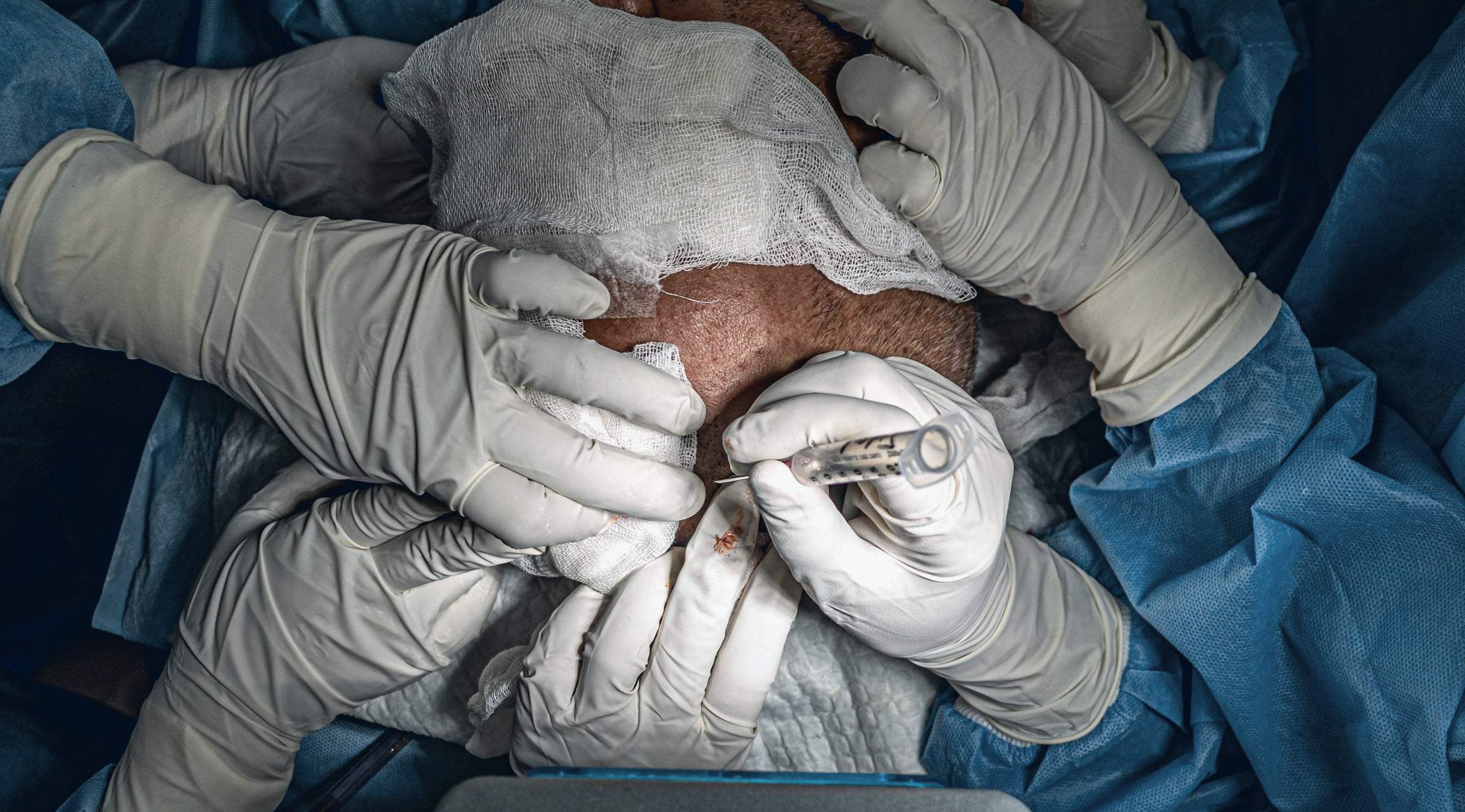
The plasma is injected into the thinning areas with a very fine needle. Your doctor may cool or numb the scalp first.
Afterwards
Most people go back to normal activities the same day. Your doctor tells you when you can wash your hair and exercise.
Review
Sessions are repeated on a schedule, and your doctor compares photos after a few months to see whether PRP is helping.
Questions
Questions about PRP treatment
Can PRP replace a hair transplant?
No. PRP may help existing hairs grow thicker and stay in their growth phase for longer, but it cannot create new follicles. Where the follicles have gone, only a transplant can bring hair back.
Does PRP hurt?
The injections sting, and some people find them uncomfortable. Your doctor may cool or numb the scalp first. Scalp tenderness or a mild headache for a day or so is common.
How soon will I see a difference?
Usually not before about 3 months, and studies often measure results at 3–6 months. Some people notice less shedding or thicker hairs. Others see little change, which is why your doctor reviews photos before suggesting more sessions.
How many PRP sessions are included in my package?
All our packages except Express include PRP sessions, and the number depends on the package. The prices page lists them. If you would like more, ask your coordinator.
Do I need to stop any medicines before PRP?
Tell us everything you take, including blood thinners, aspirin and anti-inflammatory painkillers, because some affect how platelets work. Never stop a prescribed medicine on your own. The doctor who prescribed it decides, together with our doctor.
Is PRP practical if I live abroad?
A first course needs several visits about a month apart, which is hard to fit around flights. Some patients plan sessions around trips they are already making, and some continue with a qualified doctor at home. Ask us to help you plan a realistic schedule.

Is PRP treatment right for you?
Send four photos. Our lead surgeon replies with your plan, graft estimate and full price, usually within 24 hours. Free, and you are not committing to anything.
Like any surgery, a hair transplant has risks. They include infection, scarring, shock loss and grafts that grow poorly. Read about the risks