Tools
Graft calculator
Pick your type and stage of hair loss and the hairline you want. See every graft on a 3D head, how much of your donor area it uses, how many sessions it takes and the likely technique.
Your hair loss
Deeper recession and a thinning crown, with a band of hair between.
Hairline design
With this pattern the hairline at the front usually stays, so its design changes little.
Donor area
AppearanceMedium light skin · Dark brown hair · Straight
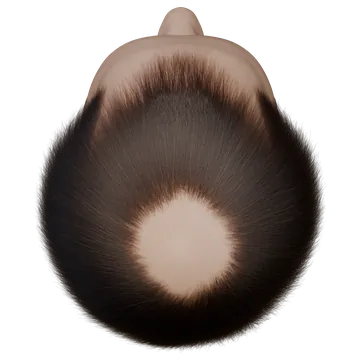
Simulation on a 3D model, not your result. Results vary.
- 1 hair
- 2 hairs
- 3 hairs
- 4 hairs
- Session 2 (hollow)
3D render of a model: an illustration, not a prediction3D render, not a prediction
Estimated plan
3,310 grafts
range 2,980–3,710 · ≈ 7,340 hairs
Graft types
- 1-hair grafts510
- 2-hair grafts1,730
- 3-hair grafts900
- 4-hair grafts170
Single-hair grafts make the first 2–3 rows of the hairline; the rest hold 2–4 hairs, depending on your donor hair.
Lifetime supply about 6,000 grafts. The mark on the bar is the most we take in one session (5,000).
- 3,310 graftsHairline, front, mid-scalp and crown
For bald or nearly bald areas: the sapphire blade allows very dense packing. At the hairline your surgeon chooses between sapphire FUE and DHI case by case.
The crown is slower: expect the full result at 12 to 18 months.
Estimate based on typical scalp areas and densities (about 40 grafts per cm² at the hairline and 26–37 behind it, the planting densities used in the published literature). Your surgeon confirms the real number, the sessions and the technique from your photos.
How the estimate works
- Each Norwood stage (men) or Ludwig stage (women) maps to typical areas of loss: hairline, front, mid-scalp and crown. Diffuse thinning spreads over the top instead.
- We multiply each area by a natural density: about 40 grafts per cm² at the hairline and 26–37 behind it, the planting densities used in the published literature, and fewer where some hair remains.
- Single-hair grafts make the first 2–3 rows of the hairline. Behind them, grafts hold 2, 3 or 4 hairs, depending on your donor hair.
- Your donor area gives about 4,000–6,000 grafts in a lifetime, more with dense donor hair, beard or chest hair. If a plan needs more, we restore the front first and say so plainly.
- We never take more than 5,000 grafts in one session. Norwood 6–7 and some Norwood 5 plans are split: hairline and front first, then the crown at least 8–9 months later.
- Sapphire FUE suits bald or nearly bald areas; DHI suits thinning among existing hair. At the hairline DHI is often used, and sapphire FUE can be better for some hairlines. Your surgeon decides the technique case by case and confirms everything from your photos.
Questions
Questions about graft numbers
How accurate is the graft calculator?
It gives a realistic range for typical scalps. Your real number depends on your hair thickness, curl, colour contrast and donor density, which your surgeon checks from your photos.
Why can’t all my grafts be done in one session?
We never take more than 5,000 grafts in one session, to protect the look of your donor area. Larger plans, and every Norwood 6–7 plan, are split: hairline and front first, then the crown at least 8–9 months later.
Will I have sapphire FUE or DHI?
Sapphire FUE is used for bald or nearly bald areas, where the sapphire blade allows very dense packing. DHI is used for thinning among existing hair, diffuse thinning and women. At the hairline DHI is often used, and sapphire FUE can be better for some hairlines. Some plans combine both, but not every plan: your surgeon decides case by case.
Does a higher number of grafts mean a better result?
Not by itself. Natural design, graft survival and density where it matters most make the result. The right number is the one your donor area can support for life.
Free tools
More ways to try your plan
Each one ends with the same next step: send the result to our lead surgeon for the real answer.
- Hairline designerDesign my hairlineShapes, heights and temple corners on a 3D model, then send it on WhatsApp.

Turn your estimate into a real plan
Send four photos. Our lead surgeon checks your donor area and replies with your real graft number, your plan and the full price, usually within 24 hours. Free, and you are not committing to anything.
Like any surgery, a hair transplant has risks. They include infection, scarring, shock loss and grafts that grow poorly. Read about the risks